Hp Laserjet Pro 4001Dn Printer Honest Review — Is the Hype Justified?
Introduction
For the past several months, my home office has been dominated by the Hp Laserjet Pro 4001Dn Printer. When I was shopping for a new monochrome workhorse, the 4001Dn was pitched by many reviewers and even some colleagues as the gold standard for small businesses and serious home offices. Its specs promise speed, reliability, and bang-for-buck operation. But, speaking honestly as an actual owner, I've found the reality to be a mix of impressive strengths and a few surprisingly stubborn shortcomings.
This review is a genuine reflection of my own journey with the 4001Dn. I’ll cover what I loved, what bugged me, and areas where the product didn’t live up to the hype. Whether you’re researching for your next upgrade or just curious about the truth behind the sales pitches, read on for the unvarnished details.
Unboxing & Initial Setup
Setting up the 4001Dn was, thankfully, a pretty painless experience — at least mechanically. The packaging felt sturdy, and the essentials (power cord, documentation, starter cartridge) were all neatly organized. Lifting the printer out wasn’t too difficult, though it does have some heft, and I immediately noticed that this was a business-grade device: solid, functional, not flashy.
Plugging it in and following the initial setup guide, I was up and running faster than with some other HP models I’ve owned. The physical control panel is straightforward; you’re not forced through endless “smart” setup apps, although those exist if you want them. Connecting the printer to my network via Ethernet was a breeze. USB connection is there as a backup, but what pleasantly surprised me was how quickly my devices (Windows laptop, MacBook, and even Linux desktop) detected the 4001Dn. HP’s Universal Print drivers worked without drama.
The only hiccup came when trying to set up remote printing and advanced features — more on that later.
Build Quality & Design
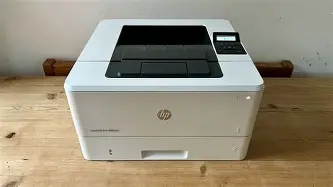
Let’s be clear: this isn’t a style piece. The 4001Dn looks and feels like business equipment, with its sturdy matte casing and no-nonsense layout. That said, I appreciated the compact footprint, which fit nicely on my dedicated office shelf. The top output bin feels robust, and the paper drawer slides smoothly instead of that brittle feeling you get from cheaper printers.
One detail I quickly appreciated: the main input tray holds a full ream of paper (250 sheets), and you can add a second tray if you need. Adding or replacing toner is fairly painless; HP’s locking mechanism never jammed for me, which is more than I can say for several past printers.
Performance: Printing Speed & Quality
Here’s where the 4001Dn starts to justify its reputation. The rated speed is up to 42 pages per minute, and in my everyday office tasks — invoices, reports, multi-page legal documents — it consistently delivered. I timed some real print runs, and for 20-page jobs, it really did spit them out in under a minute. There’s barely any startup lag: from sleep mode to outputting a page took less than 10 seconds in my experience.
Print quality was razor-sharp for text, which is the main event for a monochrome laser. Even at default settings, small fonts were perfectly legible, and line weights didn’t blur. For occasional grayscale graphics and embedded charts, performance was adequate but nothing to brag about — subtle gradients sometimes appeared a bit banded or muddy. No surprise there, but worth knowing if you print lots of images.
What did surprise me — and not in a good way — was how much noise the printer makes on larger jobs. Short bursts are fine, but when printing 30-40 pages in a row, you absolutely hear it chug along. It’s not disruptive, but I’d hesitate to put this in a noise-sensitive shared space.
Shop the latest Electronics picks on Amazon.
Shop Amazon →Connectivity: Wired Reliability, Wireless Annoyances
As a “Dn” model, the 4001Dn is built around Ethernet networking, and wired connections are the definition of stable. I never once lost a print job or had to restart the device because of a network dropout. That’s a huge relief compared to some flakiness I’ve had with all-in-one printers.
However, the lack of built-in WiFi was a real frustration. For my setup this wasn’t a dealbreaker, but in hindsight I missed the convenience of sending a quick print from my phone or tablet (unless I routed it through my home network). HP does offer WiFi options in related models, but I wish wireless had been included standard on this mid-range unit. Thankfully, USB works reliably if you have to connect directly.
Software & HP Smart
Here’s where the “modern” HP experience shows its dual nature. On the one hand, drivers and basic utilities are easy to install and mostly fade into the background. The printer’s onboard web interface is user-friendly if you want to check status, manage queues, or update firmware.
On the other hand, integrating with HP Smart (their cloud printing and scanning tool) was clumsy. Initial sign-in and registration failed the first two times, and some “instant ink” prompts kept popping up even though this model doesn’t use that service. Remote printing worked after some back-and-forth, but I quickly went back to using standard network printing because it was just less hassle. This is a small thing, but it speaks to the sometimes fragmented nature of HP’s software experience.
Paper Handling & Duplexing
The 4001Dn is designed for double-sided (duplex) printing, and it does that reliably. I routinely ran multipage double-sided documents without jams. I also appreciate that the output bin is well-designed — pages never scattered or missed the bin, even in big jobs. Manual feed works for envelopes and letterheads, though you have to set the slider position very precisely or risk a skewed print.
If you’re printing specialty stocks, like labels or heavier card paper, you do need to check compatibility. I had one incident where a thicker label sheet jammed, and clearing it was more tedious than expected (the path is a bit buried). But for standard office use, jams have been rare — a very pleasant surprise after years with less reliable printers.
Maintenance & Running Costs
Toner yield is terrific. I went over two months and printed roughly 2,000 pages before even thinking about replacing the cartridge. HP’s original toners are not the cheapest, but the per-page cost is reasonable for the output quality and reliability. That said, generic alternatives did trigger an occasional “non-HP toner installed” warning, though it never actually stopped me from printing.
Scheduled maintenance is straightforward. Occasional cleaning and keeping the firmware current were all that was needed. After several months, I haven’t seen any creeping issues with feeding, ghosting, or streaks, which speaks to the solid engineering at work here.
Energy Use & Reliability
The 4001Dn features automatic sleep modes, and it reliably wakes up when a job is sent its way. My electricity bill didn’t budge after adding it to my setup, which is more than I can say for some previous units. I also appreciate the physically robust power switch — it’s reassuringly old-school.
After hundreds of jobs, no odd errors, no frozen panels. Reboots are fast if needed after a firmware update. If business continuity is your priority, this printer earns its keep.
Looking for the best Electronics deals on Amazon?
Shop Amazon →What I Liked (Pros)
- Outstanding print speed: Easily handles big jobs without lagging; real-world speeds match the specs.
- Excellent text quality: Crisp, sharp documents every single time.
- High page yield: Toner life exceeded my expectations; low interruption for cartridge swaps.
- Sturdy and compact build: Fits neatly in a home office, feels tough enough for heavy use.
- Reliable wired networking: Rock-solid via Ethernet; no connection dropouts in months of use.
- Duplex printing works flawlessly: Never jammed on me during double-sided print runs.
- Simple, non-cluttered control panel: Easy enough for non-techie family members to use.
Room for Improvement (Cons)
- Lack of wireless connectivity: No built-in WiFi limits flexibility for modern homes and offices.
- HP Smart software is clunky: Initial setup and account linking was needlessly complicated.
- Generic toner warnings: Acceptable, but still slightly annoying if you experiment with third-party supplies.
- Noisy on long jobs: Noticeably loud when churning through 30+ page runs.
- Average grayscale graphics: Not ideal for image-heavy reports or presentations.
- A bit heavy: Not the most portable if you plan to move it often.
Hp Laserjet Pro 4001Dn vs. Similar Models
| Feature | Hp Laserjet Pro 4001Dn | Brother HL-L5200DW | Canon imageCLASS LBP223dw |
|---|---|---|---|
| Print Speed (PPM) | 42 | 42 | 40 |
| Wireless Connectivity | No | Yes | Yes |
| Automatic Duplex | Yes | Yes | Yes |
| Paper Capacity | 250 (expandable) | 250 (expandable) | 250 (expandable) |
| Approx. Price Range | Mid-range | Mid-range | Mid-range |
| Noise Level | Above average | Average | Average |
| Build Quality | Robust, compact | Robust, slightly bulkier | Solid, slightly lighter |
| Best For | Ethernet-wired offices, text-heavy jobs | Small office/home with WiFi needs | Quiet/home office with wireless preference |
Buying Guide: How to Choose the Right Office Printer
Evaluating printers today means finding a balance between features, reliability, and ongoing costs. Here’s what I recommend considering, based on my experience with the Hp Laserjet Pro 4001Dn and competing models:
1. Assess Your Connection Needs
The biggest practical frustration I encountered was the lack of built-in WiFi on the 4001Dn. If you keep everything wired, this won’t matter, but for multi-user households or BYOD (bring your own device) offices, built-in wireless may be essential. If that’s you, look for the “dw” variations or competitor models.
2. Focus on Print Volume and Cost Per Page
How many pages do you print monthly? The 4001Dn really excels when you move hundreds (or thousands) of pages each month, and HP’s high-yield cartridges are cost-effective. If your needs are lighter, you might find the extra speed and capacity go unused — and a smaller, less expensive printer could serve you just as well.
3. Prioritize Support and Management
HP’s web interface is friendly, but I found the “Smart” cloud features distracting at times. If you want genuine remote management, check which devices in your shortlist have mature, well-rated software. Don’t just trust the sticker on the box — look for real-world feedback.
4. Think About Noise and Environment
This was something I underestimated. For a personal office or studio, the 4001Dn’s noise is background-level. But if your workspace is shared or super quiet, you might want a quieter unit or a printer that throttles its fan after jobs.
5. Don’t Overbuy on Features
Every feature sounds great until you remember you just need a reliable, fast text printer. If you rarely need color or scanning, don’t spend extra. For strictly black-and-white text and basic graphics, the 4001Dn is still a workhorse.
Conclusion
After several months living with the Hp Laserjet Pro 4001Dn, I can honestly say it’s one of the most reliable monochrome office printers I’ve owned. It’s not flawless — the absence of wireless connectivity and the noisy output are persistent (if minor) annoyances. But where it counts, this model delivers: print jobs are fast, sharp, and uninterrupted; toner life is impressive; and day-to-day operation is painless.
Is the hype justified? For medium to high-volume users, or anyone who really values print speed and crisp documents, the answer is yes — with a few caveats. If you need flexible wireless workflows, or you’re sensitive to noise, you might want to consider alternatives. But for a solid, no-nonsense office printer that simply gets the job done — without the drama — the 4001Dn earns its place. My workspace has run smoother with it, and I have far fewer headaches dealing with print issues. That, to me, is worth a lot.